
EZT30WI DRC All Purpose Wipes
EZT30WI Light Weight DRC Color Options: Product Specifications Detail Product Style Pop-Up Box Sheet Size 9″ x 16″ (23x42cm) Color White Units per Case 9 Quantity per Case 900 Cases per Pallet 48 Quantity per Case UOM Sheets/Case Request Pricing Request Samples Sales Sheet For everyday cleaning and general-purpose wiping, these lightweight DRC wipes offer a dependable balance of strength, absorbency, and value. Designed for routine cleaning tasks, they provide a practical alternative to traditional rags across manufacturing, industrial, commercial, automotive, and transportation environments. Applications & Recommended Uses EZPZ Lightweight DRC All Purpose Wipes are designed for light- to medium-duty cleaning tasks where reliable performance and versatility matter. Ideal for wiping surfaces, cleaning equipment, absorbing minor spills, and general workplace cleanup, their lightweight yet durable construction makes them suitable for everyday use across manufacturing, industrial, commercial, automotive, and transportation environments. Care EZPZ Lightweight DRC All Purpose Wipes are intended for single-use cleaning and should be discarded once soiled or when cleaning performance declines. No laundering or reuse is required or recommended. Store wipes in their original packaging in a cool, dry place to help preserve their strength and absorbency until needed. Discover More Options EZTSCBR Low-Linting Spunlace Wipes 12″ x 12″ View details EZTSCBQ Low-Linting Spunlace Wipes 12″ x 13″ View details EZT70WI Premium Wipes 8.25” x 16” View details Placing an order is easy. Contact our team for pricing & samples. Order now
EZT40WI DRC All Purpose Wipes
EZT40WI Heavy Weight DRC Color Options: Product Specifications Detail Product Style Pop-Up Box Sheet Size 9″ x 16″ (23x41cm) Color White Units per Case 9 Quantity per Case 900 Cases per Pallet 30 Quantity per Case UOM Case/Pallet Request Pricing Request Samples Sales Sheet For demanding general cleaning, these heavy-duty DRC wipes deliver the strength, absorbency, and versatility needed to handle everyday messes and tougher wiping tasks. Designed for reliable performance across manufacturing, industrial, commercial, automotive, and transportation environments, they provide a durable alternative to traditional rags for a wide range of cleaning applications. Applications & Recommended Uses EZPZ DRC All Purpose Wipes are designed for general-purpose cleaning and wiping tasks that require added strength and absorbency. Their durable DRC construction makes them ideal for wiping surfaces, absorbing spills, cleaning equipment, and replacing traditional rags across manufacturing, industrial, commercial, automotive, and transportation environments. Built to handle demanding everyday tasks, they offer dependable performance and versatility in busy workspaces. Care EZPZ DRC All Purpose Wipes are intended for single-use cleaning and should be discarded once heavily soiled or when cleaning performance declines. No laundering or reuse is required or recommended. Store wipes in their original packaging in a cool, dry place to help preserve their strength and absorbency until needed. Discover More Options EZTSCBR Low-Linting Spunlace Wipes 12″ x 12″ View details EZTSCBI Low-Linting Spunlace Wipes 9″ x 16.5″ View details EZT70WI Premium Wipes 8.25” x 16” View details Placing an order is easy. Contact our team for pricing & samples. Order now
Antimicrobial Wipes vs Food Service Wipes: What’s the difference?
Key Takeaways : Food service wipes are an economical choice for everyday tasks like wiping tables, counters, and spills. Antimicrobial wipes are better suited for heavier, frequent cleaning while helping the wipe stay fresh and odor-free. Both wipes can work together, with different types or colors assigned to specific cleaning zones and tasks. In foodservice environments, not every wiping task requires the same type of wipe. A restaurant kitchen, bar, cafeteria, or hospitality operation may need wipes for everything from cleaning up spills and wiping countertops to handling heavier, more frequent cleaning throughout the day. That’s where choosing the right wipe matters. Two common options are food service wipes and antimicrobial wipes. Both are designed for foodservice and hospitality environments, however, they serve slightly different purposes. So, what’s the difference between antimicrobial wipes and food service wipes—and which one is right for your operation? What Are Antimicrobial Wipes? Antimicrobial wipes are designed with antimicrobial properties that help inhibit the growth of microorganisms within the wipe itself. The EZPZ EZF150WQ Antimicrobial Wipe, for example, is designed to help prevent bacterial growth and keep the wipe fresh and odor-free even after repeated use. It has a 20″ x 13″ sheet size in blue and white color options. It also comes quarter-folded for easy dispensing. Antimicrobial wipes are particularly useful when wipes are being used frequently throughout the day and need to remain fresh between uses. The EZPZ antimicrobial line is designed for foodservice and hospitality applications, including food prep areas, commercial kitchens, bars, and tabletop cleaning. The wipes are intended for heavier wiping tasks than the standard food service wipes. Antimicrobial wipes are a good fit for: Heavier-duty wiping tasks Food prep areas Commercial kitchens Bars Tables and countertops High-frequency cleaning environments Applications where odor control and freshness are important Why Are Food Service Wipes? Food service wipes are designed for everyday cleaning tasks in restaurants, bars, kitchens, and other foodservice environments. They provide a reusable, economical alternative to traditional bar mops and rags. For example, the EZPZ EZF200PQ Food Service Wipe is designed for light-duty, everyday cleaning. It comes in pink and blue. Its 20″ x 13″ size makes it suitable for wiping down counters, food prep areas, and front-of-house tables. The wipe can be rinsed and reused multiple times before being discarded. The EZF200PQ is also designed with a cloth-like, low-lint construction, making it a practical replacement for traditional bar mops that require regular laundering. Food service wipes are a good fit for: Wiping countertops and prep areas Cleaning tables and other front-of-house surfaces Managing everyday spills General kitchen cleanup Replacing reusable bar mops and rags For operations that need an economical wipe for routine cleaning throughout the day, food service wipes can be a simple and practical solution. Antimicrobial Wipes vs. Food Service Wipes: Key Differences At first glance, these wipes can seem very similar. Both are 20″ x 13″, quarter-folded, reusable during the day, and designed for foodservice environments. The biggest difference comes down to the level of cleaning and the properties built into the wipe. Feature Food Service Wipes Antimicrobial Wipes Primary use Everyday cleaning Heavier, frequent cleaning Typical applications Counters, prep areas, tables Prep areas, kitchens, bars, tables Antimicrobial properties No Yes Reusable during the day Yes Yes Size 20″ x 13″ 20″ x 13″ Fold Quarter-folded Quarter-folded Colors Blue & White Blue & Pink Alternative to bar mops Yes Yes Sheets per box 200 150 The EZF200PQ contains 200 sheets per box, while the EZF150WQ contains 150 sheets per box. Which Wipe Should You Choose? The right choice depends on the cleaning demands of your operation. Choose antimicrobial wipes for heavier, frequent wiping. If your operation puts more demands on its wipes or you’re looking for a wipe with antimicrobial properties, antimicrobial wipes may be the better fit. The EZF150WQ is designed for heavier wiping tasks and incorporates antimicrobial properties intended to inhibit microbial growth within the towel and help keep it fresh and odor-free during use. Choose food service wipes for everyday cleaning. If your team primarily needs an economical wipe for wiping down tables, counters, prep areas, and other surfaces throughout the day, food service wipes are a practical choice. The EZF200PQ is designed specifically for light-duty, everyday cleaning and can be rinsed and reused multiple times before disposal. It’s Not Always About Choosing One Food service wipes and antimicrobial wipes don’t necessarily need to compete with each other. Many foodservice operations have different cleaning zones and different wiping needs throughout the day. A restaurant could use standard food service wipes for routine table and counter cleaning while stocking antimicrobial wipes for areas that require heavier or more frequent wiping. Color-coded options can also help organize wiping systems and separate cleaning tasks. EZPZ offers both food service and antimicrobial wipes in multiple color options. The goal isn’t simply to find the “best” wipe. It’s to match the wipe to the job. The Bottom Line Food service wipes are built for economical, everyday cleaning in foodservice environments. They’re a practical alternative to traditional bar mops and rags and can be reused throughout the day. Antimicrobial wipes offer additional antimicrobial properties and are designed for heavier, frequent wiping where keeping the wipe fresh during use is an important consideration. Both can play an important role in a professional cleaning program. The best choice depends on your application, cleaning frequency, and the level of performance you need from your wipe. Looking for the right wipe for your foodservice operation? Explore EZPZ Brands’ food service wipes and antimicrobial wipes to compare your options and find the right fit for your customers or facility.
Blue Shop Towels vs. Heavy-Duty Disposable Wipes: Which Should You Use?
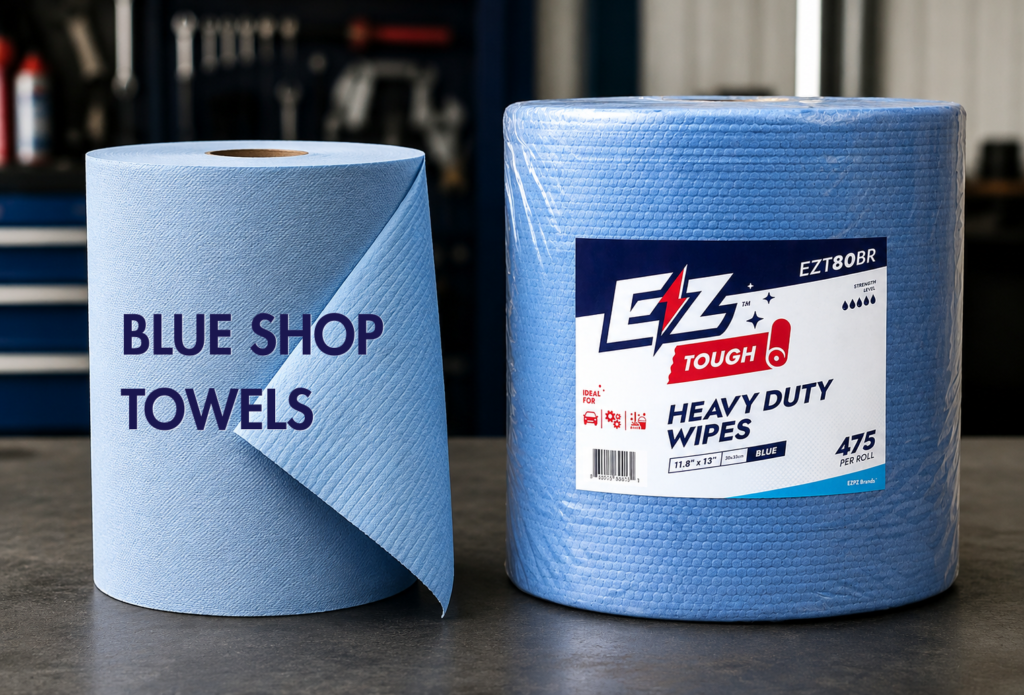
Key Takeaways : Blue shop towels work well for everyday jobs like oil, grease, and general cleanup. Heavy-duty wipes are better for demanding tasks requiring strength, low lint, or solvent compatibility. The best approach is to use the right wipe for the job instead of relying on one product for everything. Walk into almost any garage, automotive shop, or manufacturing facility, and you will likely find a roll of blue shop towels nearby. They are convenient, familiar, and useful for everything from checking oil to wiping grease off tools. But are standard blue shop towels strong enough for every job? And when does it make sense to step up to a heavy-duty disposable wipe? A recent discussion among mechanics raised an important point: most shops do not need to choose one wiping product for every task. Blue shop towels, reusable rags, and heavy-duty disposable wipes each perform best in different situations. What Are Blue Shop Towels? The term “blue shop towels” can refer to several different products: Disposable blue paper shop towels sold in rolls Laundered blue cotton towels supplied through a rental service Blue nonwoven industrial wipes made from materials such as spunlace Although these products may look similar, their performance can be very different. Material, thickness, construction, and absorbency determine how well a towel handles oil, solvents, metal surfaces, and repeated scrubbing. Standard disposable blue shop towels are typically stronger and more absorbent than household paper towels. They are commonly used for automotive maintenance, grease, oil, fluids, and general garage cleanup. Why Are Blue Shop Towels So Popular? Blue shop towels offer a practical balance of strength, portability, and convenience. They handle oil and grease better than ordinary paper towels Household paper towels are designed primarily for light spills and everyday cleaning. When used with oil, grease, or automotive fluids, they may quickly become saturated or begin to fall apart. Blue shop towels are generally more durable when wet, making them better suited for: Changing oil Checking and refilling fluids Cleaning greasy tools Wiping hands during repairs Handling small automotive spills General workbench cleanup They are easy to identify The blue color helps distinguish shop towels from products used in restrooms, kitchens, or other areas of a facility. Color coding can also help operations assign different wipes to different tasks. However, color alone does not indicate a towel’s material, strength, or intended application. Buyers should always review the product specifications. They are convenient Disposable rolls can be placed on standard dispensers, tool carts, workbenches, or inside service vehicles. Workers can take the number of sheets they need and discard them after use. That convenience is especially valuable when a clean towel is more important than reusing the same rag throughout the day. Where Standard Blue Shop Towels Fall Short Blue shop towels are versatile, but that does not mean they are the best choice for every job. A mechanic participating in the Reddit discussion explained that disposable wipes were preferred for cleaning tools, safety glasses, mirrors, sealing surfaces, and engine parts because the shop’s laundered rags sometimes came back greasy or contained small pieces of metal or glue. That distinction matters. A towel used to wipe a dipstick does not have to meet the same requirements as one used to prepare a sealing surface. Precision cleaning For delicate parts, glass, polished metal, or surfaces being prepared for paint, sealant, or adhesive, lint and residue can create problems. A low-linting heavy-duty wipe is often a better choice for: Preparing engine components Cleaning sealing surfaces Wiping parts before assembly Applying or removing solvents Cleaning safety glasses and mirrors Preparing surfaces for paint or adhesive Scrubbing rough surfaces Some paper-based blue shop towels can tear when used repeatedly on bolts, unfinished metal, sharp edges, or textured machinery. A stronger nonwoven wipe is more suitable when the job requires pressure and repeated scrubbing. Large spills Neither blue shop towels nor premium disposable wipes are necessarily the most economical way to absorb a large spill. Absorbent pads, granular absorbents, or dedicated spill-control products may be more appropriate. Using the right product for the size and type of mess helps control wiping costs. Blue Shop Towels vs. Laundered Shop Rags Reusable cotton shop rags remain common because they are durable and familiar. They can be a reasonable option for wiping up large amounts of grease or handling rough, noncritical cleaning jobs. The concern is consistency. A commercially laundered rag may look clean without being suitable for every surface. Depending on how it was collected, processed, and inspected, it could retain grease, metal fragments, adhesive, chemicals, or other contaminants from a previous use. That does not mean reusable rags have no place in a shop. It means they should not automatically be used for every task. A simple division works well: Cleaning task Better option General hand and tool wiping Blue shop towels Small oil and fluid spills Blue shop towels Large, rough cleanup jobs Reusable rags or spill-control products Sealing surfaces and engine parts Clean, low-lint disposable wipes Solvent application Solvent-compatible heavy-duty wipes Glass, mirrors, and safety glasses Low-lint wipes Rough machinery and repeated scrubbing Heavy-duty nonwoven wipes When Heavy-Duty Disposable Wipes Make More Sense Heavy-duty nonwoven wipes are designed for jobs requiring greater strength, absorbency, or cleanliness than a standard shop towel can provide. Spunlace wipes, for example, are made by entangling fibers with high-pressure water. This creates a cloth-like material that can remain strong while wet and withstand more aggressive cleaning. They are particularly useful when: The wipe must not fall apart during use Lint could interfere with the finished surface A fresh, uncontaminated wipe is required Workers are cleaning oil, grease, ink, or solvents One stronger wipe could replace several lighter towels The operation needs more consistent performance than rental rags provide EZPZ Brands’ blue low-linting spunlace shop towels are designed for industrial cleaning and offer greater water and oil absorption than traditional textile shop rags. For more demanding scrubbing and machinery cleaning, EZT80BR heavy-duty wipes provide another blue shop
Which Wipes Should You Recommend for Glass Cleaning?
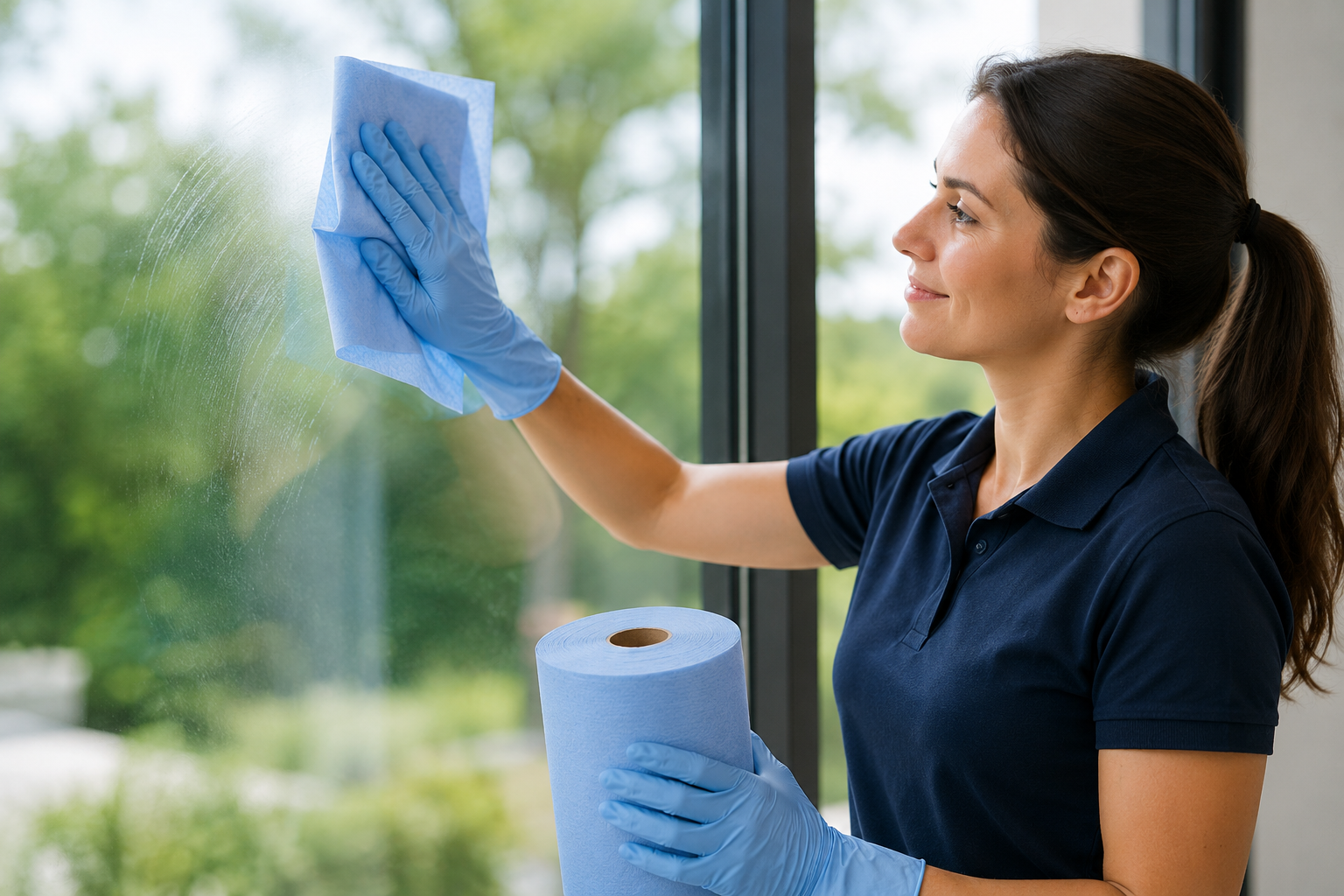
Key Takeaways : “It leaves streaks and lint” is a material problem. The wrong wipe doubles the work. Sontara-like wipes leave virtually no fibers behind, exactly what glass demands. Dust cloths are single-use. Reusing them puts the lint right back on the window. A Material Guide for Distributor Sales Reps Your customers who buy glass cleaning supplies keep asking the same question: which wipe actually works for glass and window cleaning? On a spec sheet, most options look like they could get the job done .They might all look capable of handling the tedious task of cleaning glass and windows. A recommendation is made, the product ships, and inevitably, the complaints come back. “This does an okay job but leaves streaks and lint behind.” “It doesn’t completely wipe off the excess glass cleaner.” The issue usually isn’t the glass cleaner or the technique. It’s the wipe material. And knowing the difference is what separates a distributor who can spec a solution from one who just ships what’s on the shelf. Wipe material determines everything, not all wipes are created equal. The type of material used to make a wipe determines its fiber construction, absorbency, wet and dry strength, and low-linting performance. This means that efficiency in different applications may vary. That said, a wipe that excels in one application may fail in another. Airlaid wipes, for example, are excellent for non-surgical medical applications because of their softness, but apply it on a solvent-soaked window and it gets soggy, loses its shape, and easily tears under friction. Glass is less forgiving in cleaning. Every streak, lint fiber, and missed spot shows. Here’s what you need to know to get it right . Materials For Cleaning Glass and Windows Sontara-like (Low-Lint)Wipes Sontara-like wipes, a type of spunlace, are generally considered the premium tier of disposable wipes. During manufacturing, the fibers are entangled with water jets using hydraulic technology and repeatedly washed during production. This result is a wipe that leaves virtually no fibers behind. For your customers cleaning glass windows, storefronts, mirrors, or display cases, this is the spec. . Spunlace wipes are strong wet or dry, can handle glass cleaners and solvents, and are durable enough to be washed and reused across multiple cleaning cycles. Pre-Treated Yellow Dust Cloths Yellow dust cloths are the finishing tool. A quality dust cloth is usually pre-treated to lift and pick up lingering lint, moisture or cloudiness after wet wiping. They work by trapping fine debris and absorb residual moisture quickly. This is what turns a “pretty clean” window into a streak-free one. One thing to make clear to your customers: these are single-use, dry-dusting products. Reusing them transfers residue and lint back onto the surface. The Method Matters Too Aside from the wipe used in cleaning windows, sequence matters. After the standard dry brushing, vacuuming, and scrubbing, dry wipes are usually the last step. Rushing it is what results in the callbacks. Start off with the EZTSCBI, an interfold/pop-up high-strength disposable spunlace wipe that absorbs more water and oil than traditional textile shop rags. The EZTSCBR and EZTSCBQ are also options that are made with Sontara-like technology. The EZTSCBR is made in a roll format while the EZTSCBQ comes in a quarter folded format. They expertly remove fingerprints, grime, oil, and dirt from glass windows. They can be used in both wet and dry states. Finish off with EZPZ’s pre-treated yellow dust cloth to remove any excess moisture and leave the window completely streak-free. Stock It Without the Risk And when your customers are asking about wipes for glass cleaning, you don’t need to commit to a container load to find out what sells. EZPZ Brands keeps these wipes stocked with 1-pallet minimums and roughly 2-week lead times. Want pricing or spec sheets for the EZTSCB line or the EZT16YF? Reach out and we’ll get back to you within 24 hours.