
Key Takeaways :
- “It leaves streaks and lint” is a material problem. The wrong wipe doubles the work.
- Sontara-like wipes leave virtually no fibers behind, exactly what glass demands.
- Dust cloths are single-use. Reusing them puts the lint right back on the window.
A Material Guide for Distributor Sales Reps
Your customers who buy glass cleaning supplies keep asking the same question: which wipe actually works for glass and window cleaning? On a spec sheet, most options look like they could get the job done .They might all look capable of handling the tedious task of cleaning glass and windows. A recommendation is made, the product ships, and inevitably, the complaints come back. “This does an okay job but leaves streaks and lint behind.” “It doesn’t completely wipe off the excess glass cleaner.”
The issue usually isn’t the glass cleaner or the technique. It’s the wipe material. And knowing the difference is what separates a distributor who can spec a solution from one who just ships what’s on the shelf.
Wipe material determines everything, not all wipes are created equal. The type of material used to make a wipe determines its fiber construction, absorbency, wet and dry strength, and low-linting performance. This means that efficiency in different applications may vary. That said, a wipe that excels in one application may fail in another. Airlaid wipes, for example, are excellent for non-surgical medical applications because of their softness, but apply it on a solvent-soaked window and it gets soggy, loses its shape, and easily tears under friction. Glass is less forgiving in cleaning. Every streak, lint fiber, and missed spot shows. Here’s what you need to know to get it right .
Materials For Cleaning Glass and Windows
Sontara-like (Low-Lint)Wipes
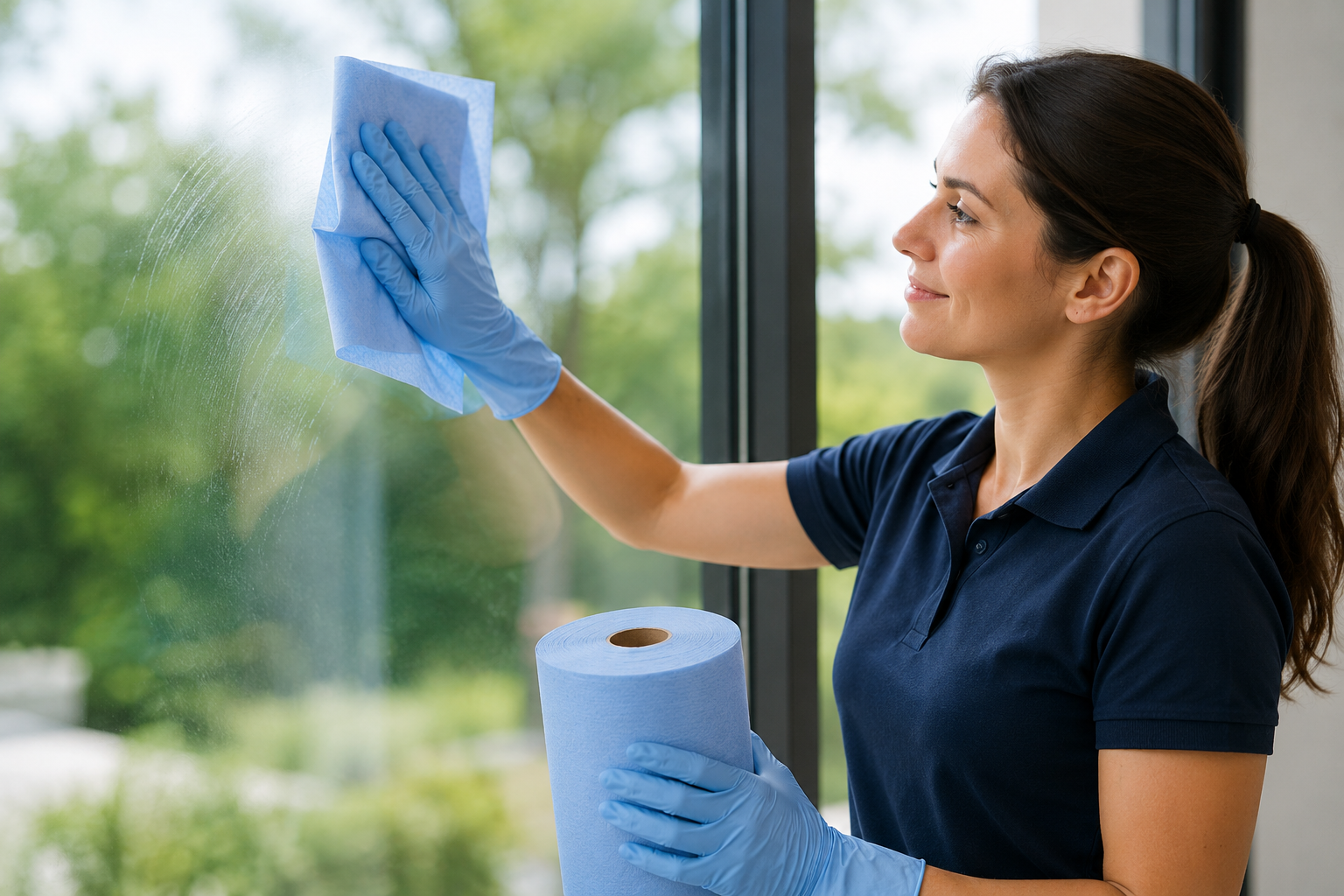
Sontara-like wipes, a type of spunlace, are generally considered the premium tier of disposable wipes. During manufacturing, the fibers are entangled with water jets using hydraulic technology and repeatedly washed during production. This result is a wipe that leaves virtually no fibers behind. For your customers cleaning glass windows, storefronts, mirrors, or display cases, this is the spec. . Spunlace wipes are strong wet or dry, can handle glass cleaners and solvents, and are durable enough to be washed and reused across multiple cleaning cycles.
Pre-Treated Yellow Dust Cloths
Yellow dust cloths are the finishing tool. A quality dust cloth is usually pre-treated to lift and pick up lingering lint, moisture or cloudiness after wet wiping. They work by trapping fine debris and absorb residual moisture quickly. This is what turns a “pretty clean” window into a streak-free one. One thing to make clear to your customers: these are single-use, dry-dusting products. Reusing them transfers residue and lint back onto the surface.
The Method Matters Too
Aside from the wipe used in cleaning windows, sequence matters. After the standard dry brushing, vacuuming, and scrubbing, dry wipes are usually the last step. Rushing it is what results in the callbacks.
Start off with the EZTSCBI, an interfold/pop-up high-strength disposable spunlace wipe that absorbs more water and oil than traditional textile shop rags. The EZTSCBR and EZTSCBQ are also options that are made with Sontara-like technology. The EZTSCBR is made in a roll format while the EZTSCBQ comes in a quarter folded format. They expertly remove fingerprints, grime, oil, and dirt from glass windows. They can be used in both wet and dry states.
Finish off with EZPZ’s pre-treated yellow dust cloth to remove any excess moisture and leave the window completely streak-free.
Stock It Without the Risk
And when your customers are asking about wipes for glass cleaning, you don’t need to commit to a container load to find out what sells. EZPZ Brands keeps these wipes stocked with 1-pallet minimums and roughly 2-week lead times.
Want pricing or spec sheets for the EZTSCB line or the EZT16YF? Reach out and we’ll get back to you within 24 hours.